AI Receipt Processing Automation
Independent Development
AI-powered automation tool for converting unstructured receipt data into business-ready records.
Industry: AI / Automation / Productivity
Purpose
Extract structured receipt data from unstructured text using AI and automate storage workflows
Timeline: June 2026
Tech Stack
Overview
Businesses and individuals often struggle with the manual entry of receipt data from unstructured formats. This project addresses the need for a seamless, automated way to convert chaotic receipt text into clean, structured data. The goal was to build a complete AI automation pipeline that extracts line items, totals, and merchant information with high precision, demonstrating how modern AI workflows can replace error-prone manual tasks.
Developmental Challenges
The development process involved orchestrating multiple services that are needed to communicate reliably. A major hurdle was Docker networking—enabling a containerized n8n instance to talk to a local Express backend required implementing specific host configurations. Additionally, mapping dynamic JSON payloads between webhooks and API schemas required careful mapping logic. Ensuring the AI's output remained consistent and usable necessitated a strict validation layer to catch malformed responses before they reached the database.
Tailored Software Solution
The solution is an integrated automation pipeline using n8n for workflow orchestration, Express/TypeScript for the AI-processing backend, and OpenAI's Responses API for structured data extraction. When a receipt is received via a webhook, n8n triggers the process, sending the text to the backend. The AI model parses the unstructured text into a deterministic JSON format, which is then validated using Zod to ensure schema compliance. Finally, the structured record is persisted in a Supabase PostgreSQL database, making it available for downstream business applications. This architecture provides a reliable, scalable, and reusable API for receipt processing.
System & Workflow Architecture
System Architecture
n8n Workflow
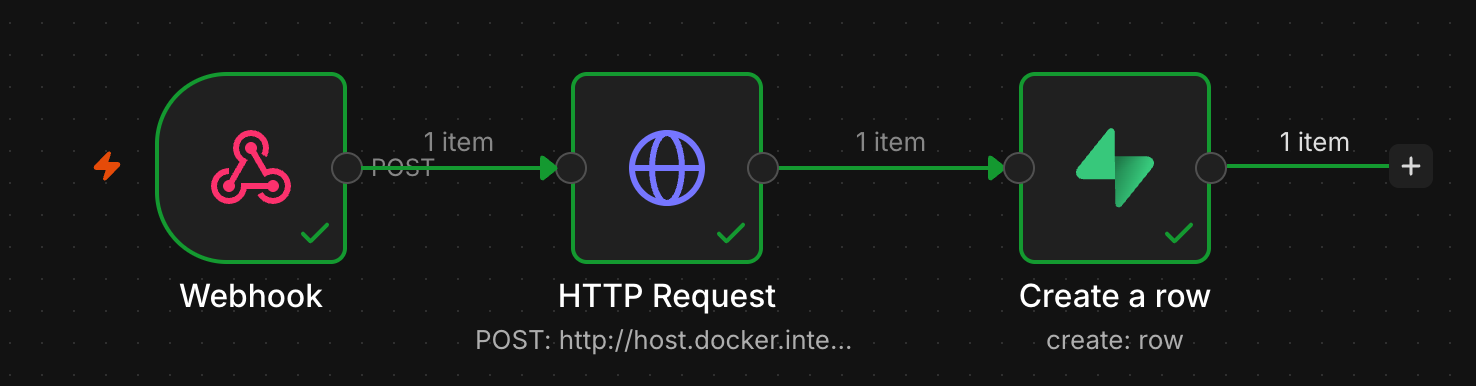
Measurable Results & Impact
The project successfully demonstrated an end-to-end automation workflow that eliminates manual data entry. By leveraging AI for extraction and n8n for orchestration, the system can process receipts in seconds with high accuracy. The implementation of Zod validation resulted in zero database insertion failures due to malformed AI responses during testing. The final result is a production-ready automation pattern that can be adapted for any document-to-data extraction use case, significantly improving operational efficiency.
Key Features Implemented
- ✓AI-powered receipt parsing with structured JSON extraction using gpt-5 model (fastest and most cost-efficient)
- ✓n8n workflow orchestration mapping incoming webhooks to the extraction API
- ✓Zod schema validation safeguarding the database against malformed AI responses
- ✓Automated dual-format export saving results to both JSON and CSV files with timestamps
- ✓Persistent cloud database storage using Supabase with default timestamp constraints
- ✓Interactive Next.js user interface enabling quick uploads and parsed results display
- ✓Express/TypeScript backend hosted on Render featuring endpoint health checks